
After the teaser dropped for Christopher Nolan’s The Odyssey, the reactions were deadly to its box-office prospects. For a film that cost upwards of $250 million, the last thing it could be was boring. The chattering class mocked their accents, said it looked “like a slog,” and that could spell catastrophe for Universal.
Nolan’s first effort after his Oscar-winning smash hit, Oppenheimer, would have to be a big hit, and it will be. It will likely make $1 billion worldwide, and, just as I predicted, the dumb culture war surrounding it will end with a whimper, not a bang. This isn’t Supergirl or Snow White. It won’t be taken down so easily.
In case you know nothing about it, the culture war arrived like a deus ex machina for the film, as the early buzz was muted at best. Suddenly, it became a must-see, with women turning out in droves where they might not have otherwise. Seeing it became a political act, and wait until the sanctimonious TikToks start to roll out, and they will.
If the studio leaked the news to change the conversation or generate controversy, that was a good move, and it worked. With two sides of the Virtual Civil War going at it, with some in between pleading, come on, guys, it’s just a movie! Things have gotten ugly on X of late, with the two main tribes known as the Virtue Signalers vs. The Trolls going at it for days now.
The two main objections seemed to be that Elliot/Ellen Page stars in a male role when half of America is still not on board with transgender ideology, and an African actress, Lupita Nyong’o, was cast as Helen of Troy. Both of these choices seem to demand an opinion one way or the other. It’s the elephant in the room. It then became a struggle session, as anyone who would dare criticize either of them in any way would be deemed a racist or a transphobe. I’ve gotten myself into trouble yet again on X, and the totalitarians are coming for me.
The same people who go along with something like this:

The Left is obsessed with identity and race, and yet, Nolan has engaged in “color blind” casting, which demands we just forget all of that. But the film depicts what I think of as the idealized worldview of Woketopia, where everyone has a seat at the table, and there is no such thing as race or gender to decide our fate.
That idealized worldview is on display in movies I think of as Peak Woke. They don’t take us to a specific time and place, like, say, Suburbia, Nazi Germany, or a Tuscan village. It’s a place defined and shaped by aspirational progressives when culture and politics have merged.
What we were building, where we were taking society, was directly threatened when Donald Trump won in 2016. What happened to the Left to cause mass hysteria, extreme anxiety, and chaos can be described as a utopia disrupted.
This trauma has played out in many Peak Woke movies of late, including last year’s Best Picture winner, One Battle After Another, but other films on tap for this year, including Digger, Wild Horse Nine, and the Social Reckoning, all dealing with the same theme of an existential threat that feels like the end of the world. But really, it’s just a sign that their empire is collapsing.
What we see on screen in The Odyssey is a depiction of their idealized worldview, but it flattens any true sense of what we’re all living through now. It is a perspective from people who have been insulated from the rest of society and seek to correct them, and in so doing, correct our world.
That is why we see people cast merely because of their race, like Lupita Nyong’o, who is given absolutely nothing to do except sit there, because the casting choice is the story. That is what is most meaningful about it.
Just criticizing Nyong’o as Helen of Troy is deemed “racist,” but it’s also what one might call a struggle session. It’s a little like wearing a mask in 2021, after we all found out that masks barely worked if at all. Wearing them became a symbolic act of compliance and an easy way to identify who was who. Who was part of the Blue tribe and who wasn’t. This works the same way.
No one would dare say Nyong’o wasn’t the universal object of desire, even if the whole point of her casting was not to objectify her but to illustrate that men are the drivers of war, and taking the more feminist route by alleviating the blame from Helen after all of these years.

All of the female characters have been given a feminist rewrite, whether that’s by stripping them of their sexual power (which only makes the movie even more boring) or by redeeming them from blame for keeping Odysseus from getting home.
Circe and Calypso, for instance, were his lovers, and yet, there is no such sexual expression or desire or even flirtation in this film. Odysseus is buttoned up, not even the Sirens can squeeze out a drop of sexual heat from this very sexless, puritanical read of Homer.
What I see and what I got in trouble for was daring to suggest that Lupita Nyong’o doesn’t actually meet the definition of the ultimate object of desire, or one that would necessarily appeal to the male gaze.
This is considered blasphemy on the Left, even if I said the same thing about Milly Alcock in Supergirl. But to the Woketopians, Nyong’o isn’t so much a real person but rather a religious symbol. Elevating her helps justify their “goodness.” But it also robs her of her right to be seen as a real person.
Beauty, per the male gaze, has never been anything we ever had to question in movies because Hollywood just knew how to deliver for male audiences. This changed only recently, with what Helen Andrews would call the Great Feminization.
I can’t argue that Nyong’o isn’t beautiful because she is. I am merely trying to explain why there is so much controversy around it, and it can’t be explained just by calling everyone a racist.
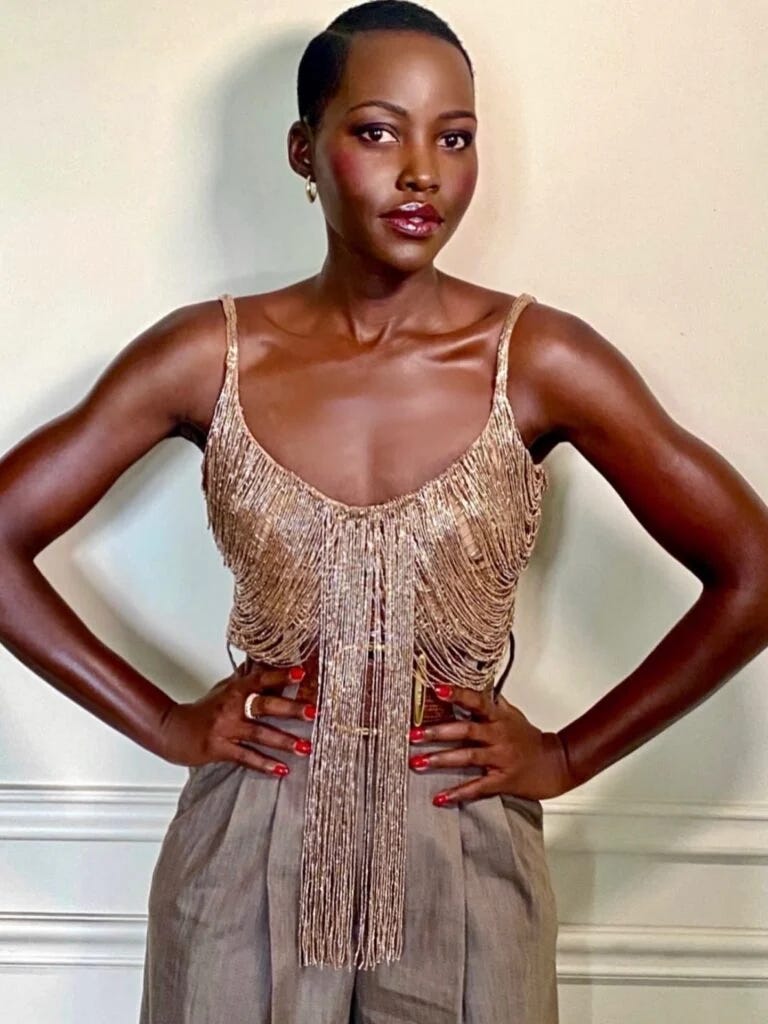
The virtue signalers will want to be kind and never talk about the elephant in the room, but I figure, why not? What’s the worst that can happen? Oh, you know, getting called a racist by Film Twitter all day long.
But we do have to talk about it because things have dramatically changed. The Male Gaze is something that activists, and now Hollywood, have been systematically dismantling by design. It’s just not there anymore in movies and many TV shows. We rarely see hot people, which is strange. We see a lot of older women having sex with younger men, but male sexuality isn’t something we see very often.
For instance, stripping Odysseus turns The Odyssey into a dry meditation on male angst, the oft-repeated trope of the male protagonist who is in charge of everything but feels bad about it. This was also Leonardo DiCaprio in One Battle After Another, and Cillian Murphy in Oppenheimer. It’s the only place for the male protagonist to be in American culture in 2026.
So, in a film that strips The Odyssey of lust and sexuality, it makes sense that Helen of Troy would not necessarily be an object of desire, but rather serving a different purpose, and in this movie, it seems fairly clear that this is a feminist retelling.
Women are the objects of desire only because men are corrupt. That seems to be the message we’re getting here, along with the idea that something very bad happened at the hands of a destructive force (aka Donald Trump), and that the drama playing out on screen is a utopian society reeling from that disruption.
That’s what makes it Peak Woke, along with One Battle After Another. These are films that argue about white supremacy, hetero-supremacy, racism, and the dominance of the alpha male. At least, that’s how it read to me. I expect that if you exist inside the Woketopian bubble of the Left, this film would be deeply meaningful to you.
I personally find the “Male Gaze exciting,” especially in cinema. Alfred Hitchcock, David Fincher, Stanley Kubrick, and others have often celebrated the pure beauty of women seen through the eyes of men. It is also the singular driver of reproductive evolution. That doesn’t mean that Lupita Nyong’o isn’t attractive. Of course, she is.
The Helens throughout history, going back thousands of years, depict women that men today might not find all that attractive, but were for their time. She is often depicted with bare breasts and in sexually provocative poses. The thing that seemed to matter most about her was not just her beauty but her sexuality, and of course, with Nyong’o, she is like all of the women in the film, stripped clean of it.
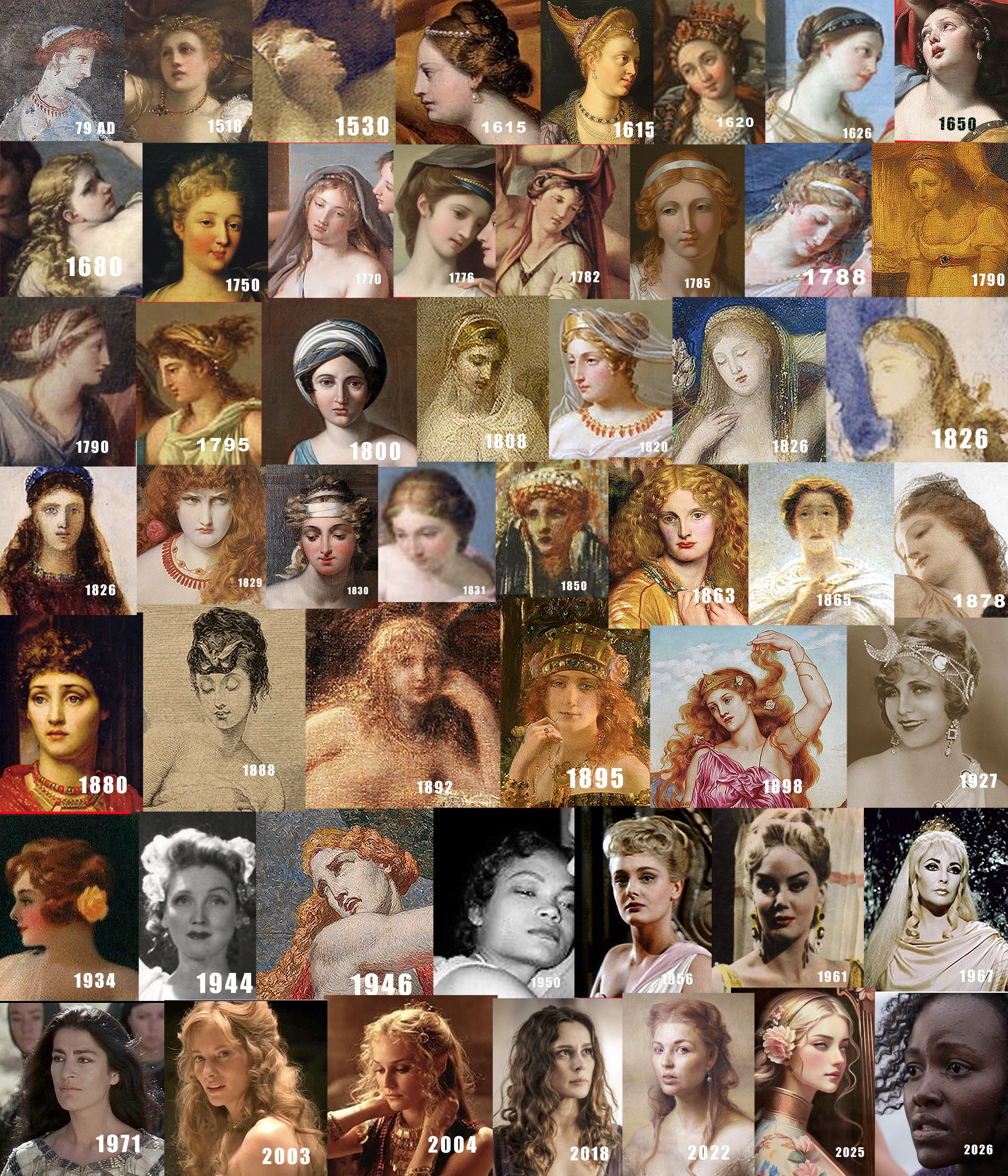
We see such a dramatic reversal, in fact, with Nyong’o as a modern-day Helen that we have no choice but to talk about it, even if her screen time is minimal. Why does it no longer matter that she be the object of desire to men everywhere? What changed? The problem is, no one is allowed to talk about it without being targeted as a “racist.”
But if we’re talking about beauty and sexuality, it is not hard to find, nor does it require any explanation. AI can do it even if Hollywood won’t:
Inside Woketopia, they must lie about everything, to themselves, to each other, to audiences. These lies are what hold them and their idealized version of what our society should be together, and when they are challenged, it becomes an existential threat.
It doesn’t matter to me much how people choose to reconstruct and deconstruct this story. The question should be, does the movie work? And for me, this movie did not. In the first fifteen minutes, I knew it would be a slog, a difficult sit for three hours of a jumbled mess of a story with no coherent through-line, no characters that felt in any way real, no dramatic tension in the characters, and a lot of action and beautiful scenery that never cohered.
The only thing I liked about the movie was Matt Damon’s performance. Even if his Odysseus wasn’t all that compelling or exciting, his performance at least showed that he had to help guide us as we tried to follow the story.
In the end, watching so many critics praise this film and being personally attacked on X for criticizing it made me start thinking about generations of moviegoers, especially the two kinds of audiences raised over the last 20 years. The social justice warriors who tend to be either LGBT or female, and the fanboys at whom most of the blockbusters coming out of Hollywood were aimed.
One thing both sides agree on is that there is a binary of good and evil and that evil must be punished, no matter what. To the Woketopians, evil is the White Male Patriarchy, and that is reflected in The Odyssey as Odysseus is, up until the final act of the movie, a muted hero who doesn’t even know his own mind, much less his way home.
For Nolan fanboys, what they want is spectacle, and Nolan delivers on that front with graphic, violent scenes and spectacular visual effects. They’re willing to overlook everything else as long as the hero saves the day.
So perhaps it is me. Perhaps I’m the problem. Maybe the kinds of movies I grew up with and the kinds of stories I love are now a thing of the past.
The kind of storytelling I respond to, and most people can recognize, is like beauty itself. It’s not that hard to define. You know it when you see it.