Nathan Fielder and Lance Oppenheim’s You Can See Everything is meant to be an intriguing examination of the relationship between disgraced wunderkind-scientist Elizabeth Holmes and her fiancé Billy Evans as they attempt a reputation-wash of the now-imprisoned Holmes.
The Curse made me a fan of Nathan Fielder. I caught up with him late and never watched Nathan For You. But in The Curse I saw the kind of storytelling Hollywood had been missing: truthful examination of the progressive Left’s hypocrisy in all its ugly glory.
And maybe, just maybe, Billy Evans saw in Fielder someone who was “based” and would be less inclined to demonize him. He could not have been more wrong, as a controlling, misogynist, Trump-supporting, Charlie Kirk-defending villain.
Evans seemed to have no idea what the film would be about, as he said in an interview with the All In Podcast the day the film released. Or maybe he did know and he was trying to get ahead of the story.
I want to talk about this movie as honestly as I can, and to do that, I have to reveal some of the film’s secrets. But if you want to experience it for yourself, with no idea what will happen next, frame by frame, intense close-up after intense close-up, skip this and buy a ticket. This is your final warning.
The Good
Elizabeth Holmes comes off as the most sympathetic of all the characters, including Fielder, as they swirl around her like planets trying to affect the tragic outcome of her once-promising life. She’s a good mom, and that seems to matter more than anything else. We want her to be with her kids, not rotting in a jail cell. What in the world could have gone so wrong?
We spend the next three hours unpacking that as Fielder attempts to understand his subject, even if she can’t confront her past and sticks to her story. That makes this an intriguing mystery to unravel.
It’s also beautifully filmed, thanks to collaborator Lance Oppenheim, known for directing music videos.
The close-ups in this film are so close you really can see EVERYTHING, like Billy Evans’ penis, along with Fielder noticing his penis, not to mention Fielder’s pimples and the difference between the blackheads and the ones he’s already picked.

Holmes, Evans, and later actress Amanda Seyfried are spared no grace as the camera lens traps every flicker of a lash, twitch of a lip, and tiny hairline crack in the skin as old age takes hold.
I didn’t expect to feel so much for Elizabeth Holmes while watching this. If the film does anything good for her, it redeems her for getting lost in the men in her life. She gives herself over completely to them, and the film’s clever twist is that Fielder himself becomes one of them. They don’t become romantically involved, but he is sucked into her wide-eyed innocence and vulnerability, too.
We are caught up in it with him since the film is told from his point of view. In this way, at least to me, it recalls Alfred Hitchcock’s Vertigo, where Jimmy Stewart becomes obsessed with a woman he can’t save. She becomes his entire world, until the lie unravels and he realizes he’s been duped.
It also echoes the great Roman Polanski film Chinatown, where Jack Nicholson inserts himself into Faye Dunaway’s life, and everything he does to make things better for her drives her closer to her own demise. He doesn’t realize it, of course, until the end.
Does Fielder recognize this about himself? He most certainly does, or at least he wants the viewer to know that he inserted himself in her story to make things better for her, but his mere presence in her life dooms her fate because now, she is trapped forever in amber as an unsolved mystery who may or may not be manipulating everyone around her.
I don’t know if I have ever cried during a documentary, but when Elizabeth Holmes had to leave her babies to go off to prison, I did cry. In that moment, I knew she had me, too. I was on her side and wanted only to see her not go to prison but to stay home and breastfeed her fussy baby and tend to her son and live her life.
I began to resent a world that would demonize her the way they had, especially the Amanda Seyfried series The Drop Out. One of the most moving scenes, and a brilliantly done sequence, is us watching Holmes watch The Drop Out and then break down in tears at its cruelty.
Later, we watch Amanda Seyfried watch Holmes watch The Drop Out and see her reaction. She feels bad, but she can’t take responsibility for her part in it, her mockery of Holmes. No actor should ever play a character they don’t like, but clearly, Seyfried, perched high atop her own perception of being a moral arbiter of human behavior, does just that.
The real Elizabeth Holmes exists beyond the characters others have written. We seem to never tire of different versions of her. You Can See Everything shows us who she really is, at least it seems to, and when you go back and watch old clips, you see that it is telling us the truth. We just weren’t ready to hear it.
The Bad
You Can See Everything is a “documentary.” That is to say, it really isn’t a documentary at all. It’s a detective story, or a mystery that we help the filmmakers unravel. It isn’t scripted, but it might as well be, since the painstaking editing tells a story and the bias could not be more clear.
Documentarians aren’t really supposed to insert themselves into the story, but the character Nathan Fielder represents, an unreliable narrator now emotionally invested in Elizabeth Holmes’s fate, tries to make things better for her. It comes down to whether Evans and Holmes will profit from the documentary or not.

If they profit from it, they could make millions. Holmes already owes hundreds of millions in restitution, so they have to keep their finances separate. Did she know Evans was trying to make that deal and then pretend not to know? From Fielder’s and Amanda Seyfried’s perspective, this question will reveal whether Holmes is good or bad, innocent or manipulative. Everyone profits from it except the subjects?
Amanda Seyfried, like Fielder, comes off worse than Holmes. Seyfried, in particular, has everything a person could want: fame, good looks, wealth, and, juxtaposed against Holmes stuck in prison without her babies, it makes her look a little shallow. We can’t help but notice that the studio and Fielder are the ones getting everything out of this deal, while profiting off of Holmes’ story.
Seyfried’s marriage fell apart in September, and Fielder admits he is going through his own breakup during filming, yet they feel justified in judging Liz and Billy’s eternal love, which has outlasted all of her time in prison, as they try to raise their kids together. So maybe, in the end, this won’t tarnish their reputations forever. Only time will tell.
The Ugly
I always feel skeptical of a 100% Rotten Tomatoes score now. It didn’t used to be this way, with a hive mind of critics, bloggers, and activists mostly in lockstep. We don’t really need critics anymore, yet they're always there, like a Greek Chorus trying to set the narrative and declare a film a success or a failure.
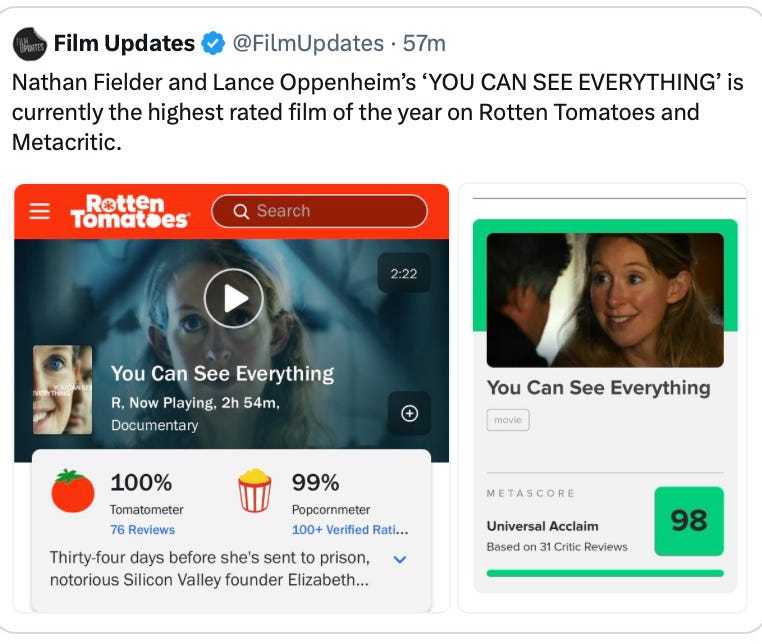
Usually, with a score like this, there is a reason why. It’s like those five-star reviews on Audible. You know it has to be political, and by political, it must affirm the Left’s worldview.
Sure enough, You Can See Everything gives them everything they need. Charlie Kirk comes up in this film because Evans turns out to be a Trump supporter confronting Seyfried on her remarks over Kirk’s death. He points out that she was roasted online for it. And she was.
But in the end she wins because the movie casts her as its only moral voice, and Evans as the supervillain, and most people seeing this film will see her as the truth teller.
At a screening in Telluride, earlier this year, when she called Charlie Kirk a p*ssy, the audience burst into applause. And they still somehow think they’re the good guys.
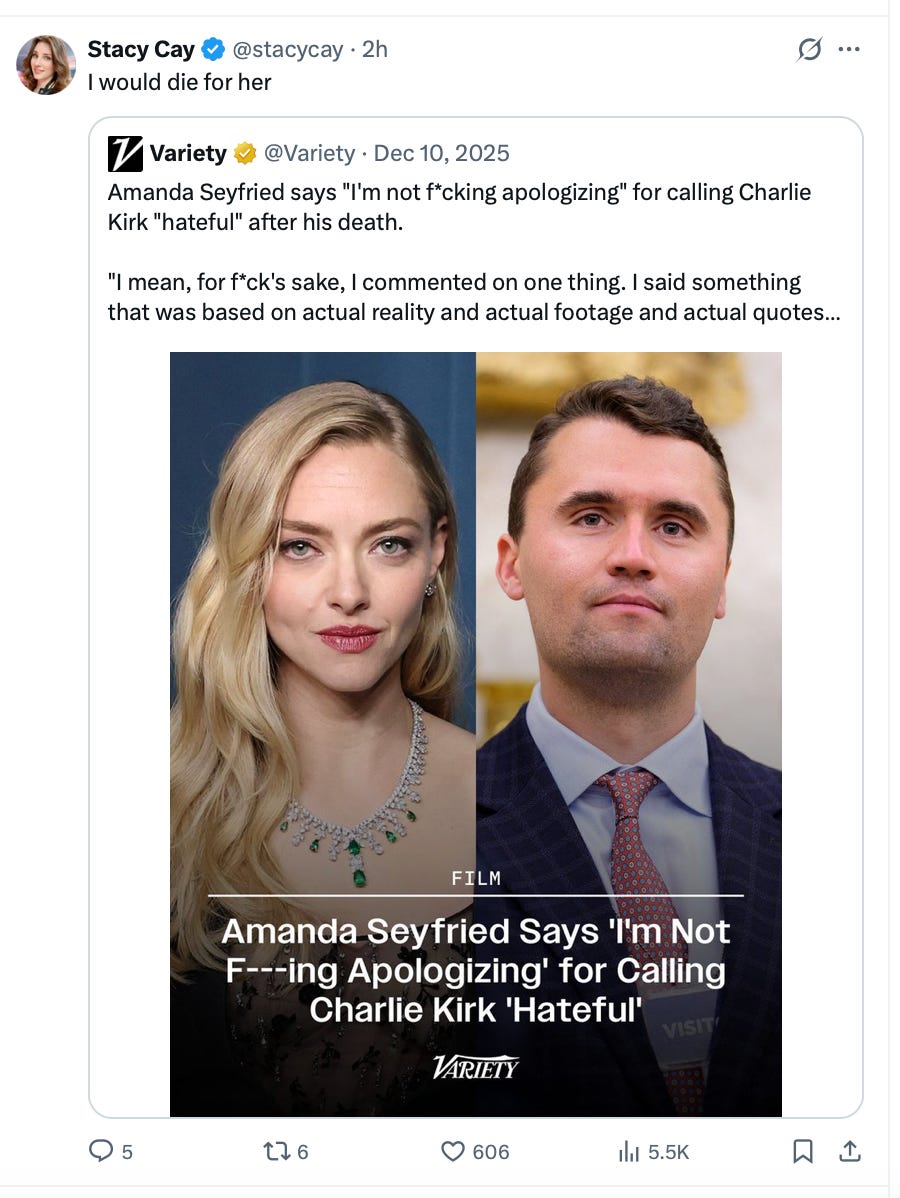
Charlie Kirk would be 33 this year and was shot in the neck at one of his debates in Utah. Like Holmes, he left two young kids to be raised without him - but unlike her, he doesn’t have brief moments of visitation. His loss has been immeasurable to the movement he built.
He has been turned into the same kind of cartoon as Holmes - a villain in the Left’s utopian fantasy, with bits of things he’s said sent around like a game of telephone. Even Barack Obama has gotten in on it in an effort to blunt Charlie’s legacy.

Seyfried is not curious enough to even ask why so many millions admire him. She would never even wonder. Like all of them, she is comfortable in her condemnation of a person based on something they said. She doesn’t really have to care because no one inside the Left’s bubble does.
Her presence almost ruins the film in my opinion. The only thing that saves it is that Fielder is smart enough to let us see everything, including Seyfried’s judgmental attitude.
The depiction of Billy, as the Trump-supporting villain, has driven much of the euphoric response to this film. It reminds me of that scene in Almost Famous where the rock star tells the journalist, “Just make us look good.” And indeed, they love this movie because it makes them look good, lets them sit comfortably in their seats, and judge the other half of the country that isn’t like them.
But few of them will walk away the way I did, with the “ick.” I wasn’t so much disgusted with what I saw on screen. This is a brilliant film that everyone should see.
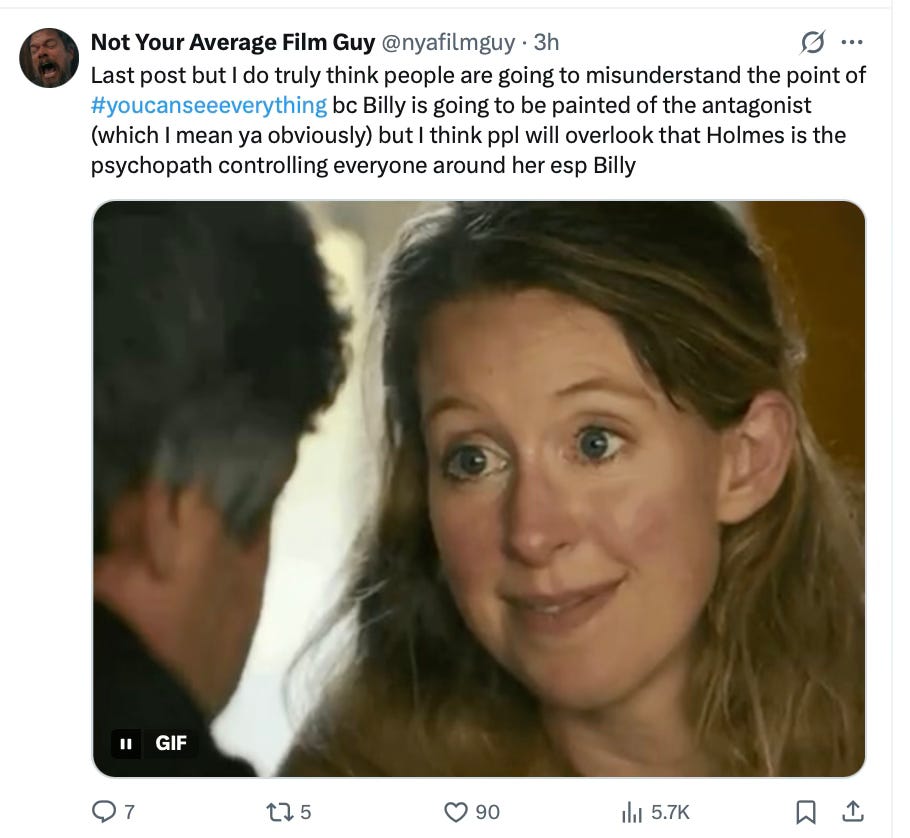
No, it was that I felt complicit in what the film does to Holmes —the same thing the film criticizes others for doing: picking at her, using her, diving in for more. It never seems enough because Holmes is a blank canvas onto which everyone can project their deepest, darkest feelings, love or hate, hope or despair.
The Verdict
Fielder and Oppenheim have made a masterpiece. There is no other way to describe it. That doesn’t mean it isn’t disturbing or perhaps even exploitative, but it is a work of genius unlike anything you’ll see this year or have seen in at least the last ten years.
I would say I loved the movie, but that isn’t the word that comes to mind. Great works of art don’t exclude you from the experience, and this one doesn’t. Even if, as with Digger, half the people watching it feel vindicated and absolved of their sins in the endless stoning of Holmes, these filmmakers won’t let you get away with it.
The title says it all: “You can see everything,” and if you think about it enough, you’ll realize that they are toying with your desire to be a voyeur and to inspect people you don’t know like insects in a lab.
The greatest directors know this about human nature - Hitchcock, Kubrick, Fincher. They know you are not an inactive participant, and sometimes they seduce you into exposing that truth. This is one of those times.